
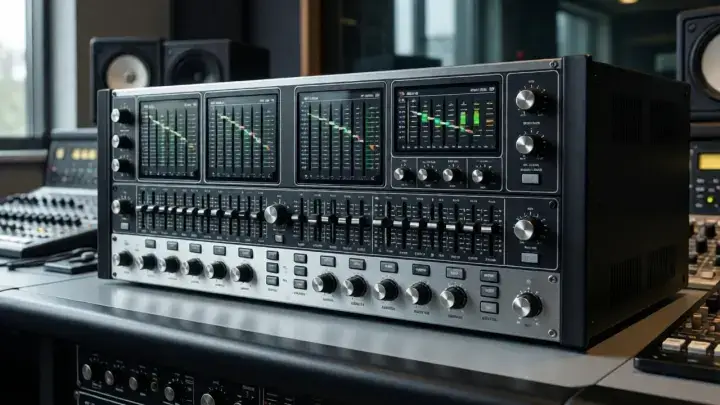
A good sound system does not simply make audio louder. It shapes what the listener actually hears.
That distinction becomes especially important when a recording feels close to being right but something about it remains unbalanced. The bass may be too heavy, voices may lack clarity, guitars may sound thin, or the highest frequencies may seem sharp and tiring. An equalizer gives the listener a way to address those problems by adjusting different parts of the audible frequency spectrum.
A quad equalizer takes that idea and divides it into four adjustable frequency bands. Instead of treating the entire sound spectrum as one continuous block, it gives the user several separate areas to work with. The result is a control system that is more flexible than a basic tone control while remaining considerably simpler than a large studio graphic equalizer.
The appeal of a four-band design is its balance between simplicity and control. There are enough controls to make meaningful changes to the character of a recording, but not so many that every adjustment becomes a technical exercise. For musicians, listeners, editors, podcasters, DJs, and audio enthusiasts, that middle ground can be useful.
Understanding a quad equalizer, however, requires more than knowing that it has four bands. The important questions are what those bands actually control, how their settings interact, why small changes can make a major difference, and when equalization improves a recording rather than simply making it different.
| FactDetails | |
|---|---|
| Subject | Quad Equalizer |
| Category | Audio equalization / sound processing |
| Primary Function | Adjusting selected frequency ranges in an audio signal |
| Number of Bands | Four adjustable frequency bands |
| Main Controls | Typically frequency, gain, and/or bandwidth depending on design |
| Common Applications | Music playback, recording, mixing, broadcasting, voice processing, live sound |
| Main Benefit | Greater tonal control than basic bass-and-treble adjustment |
| Related Technology | Parametric equalization, graphic equalization, tone control |
| Typical Users | Musicians, producers, DJs, broadcasters, editors, audio enthusiasts |
| Key Consideration | Changes should be made according to the actual sound rather than fixed settings |
| Signal Type | Can be used with mono, stereo, or multichannel systems depending on equipment |
| Practical Goal | Improve balance, clarity, separation, and listening comfort |
What a Quad Equalizer Actually Does
At its simplest, an equalizer changes the relative level of different frequencies within an audio signal.
Human hearing covers a broad range of frequencies, conventionally described from roughly 20 Hz to 20 kHz for young people with healthy hearing, although individual hearing varies and the ability to hear the highest frequencies generally changes with age. Music occupies much of this spectrum, but different instruments and voices emphasize different regions.
A kick drum contains substantial low-frequency energy. A bass guitar occupies the lower portion of the spectrum but also produces harmonics higher up. A human voice has fundamental frequencies and harmonics extending through the midrange and upper frequencies. Cymbals and other bright percussion contain considerable high-frequency content.
A quad equalizer gives the user four separate areas in which to alter this balance.
The exact design varies. Some four-band equalizers use fixed frequency points, while others allow the user to choose the center frequency of each band. Some provide adjustable bandwidth, often called Q, while simpler designs may offer only fixed bands with gain controls.
That distinction matters.
A four-band equalizer is not automatically a four-band parametric equalizer. The term “quad” primarily describes the number of bands. The actual degree of control depends on the hardware or software implementation.
Why Four Bands Can Be Enough
The temptation with equalization is to assume that more controls always mean better results. Audio engineers know that this is not necessarily true.
A large graphic equalizer might offer dozens of sliders. A sophisticated digital equalizer can provide numerous parametric bands, filters, dynamic processing, and other features. Those tools can be extremely powerful, but power introduces complexity.
Four bands occupy a useful middle ground.
One band can address excessive low-end energy. Another can shape the lower or central midrange. A third can work on vocal and instrumental presence. The fourth can influence brightness or high-frequency detail.
The arrangement is not universal, but the concept is straightforward: divide the spectrum into meaningful regions and make controlled changes rather than trying to manipulate everything at once.
This simplicity is particularly useful when the goal is not to redesign a recording but to make a modest correction.
The Four Parts of the Frequency Spectrum
A quad equalizer becomes much easier to understand when its bands are viewed as areas of sound rather than abstract numbers.
Low Frequencies
The lowest band generally deals with bass.
This region contributes weight, depth, impact, and physical sensation. Kick drums, bass guitars, synthesizers, low piano notes, and the lower components of many sound effects can contribute energy here.
Too little low-frequency content can make a recording sound weak or small. Too much can make it muddy, boomy, or overwhelming.
The challenge is that bass is strongly influenced by the listening environment. A recording that sounds balanced through headphones may become excessively bass-heavy through speakers placed near walls or corners.
A quad equalizer can help, but the control should be used carefully. Large boosts can consume significant headroom and may increase the risk of distortion or unwanted low-frequency resonance.
Lower Midrange
The lower midrange is often where warmth and body live.
Many instruments contribute energy here, as do the voices of many speakers and singers. When this area becomes crowded, several sounds can compete with one another.
The result can be a recording that feels thick or cloudy even though individual instruments sound acceptable in isolation.
A small reduction can sometimes create the impression of greater clarity without increasing the treble. That is an important principle in equalization: clarity does not always come from adding high frequencies. Sometimes it comes from removing competing energy elsewhere.
Upper Midrange
The upper midrange plays an important role in intelligibility and presence.
Speech depends heavily on this general region for clarity. Vocals, guitars, keyboards, strings, and many other instruments also contain important information here.
Too little can make a recording feel distant or dull. Too much can make voices sound aggressive and certain instruments become tiring.
Because the human ear is particularly sensitive to portions of the midrange, changes in this area can be noticeable even when the numerical adjustment appears small.
High Frequencies
The highest band generally affects brightness, air, definition, and detail.
Cymbals, high percussion, vocal harmonics, string overtones, and other elements contribute energy in this region.
A moderate boost can make a dull recording feel more open. An excessive boost can emphasize hiss, harshness, sibilance, or recording imperfections.
That is why “more treble” and “more detail” should never be treated as identical concepts.
Quad Equalizer Versus Bass and Treble Controls
Many consumer audio systems provide only bass and treble adjustment.
Those controls are useful because they are simple. A listener can quickly add warmth or brightness without needing to understand frequency bands in detail.
A quad equalizer provides a more targeted approach.
Instead of asking, “Do I want more bass?”, the user can address a particular portion of the low end. Instead of broadly increasing treble, the user can make a smaller change in a specific upper-frequency region.
This additional control can be valuable when a recording has a specific problem.
Imagine a podcast whose voice sounds muddy. Increasing treble may make the voice brighter, but it could also emphasize microphone noise and harsh consonants. A more targeted midrange adjustment may solve the underlying issue with less collateral change.
Likewise, if a song sounds overly thick, reducing a crowded midrange area may create separation without stripping away all of the bass.
Understanding Gain, Frequency, and Q
The most important concepts behind a more flexible quad equalizer are gain, frequency, and Q.
Gain determines how much a selected frequency region is boosted or reduced. Positive gain raises the level; negative gain lowers it.
Frequency identifies the area being affected. Depending on the equalizer, the user may be able to move the band to a chosen center frequency or may be limited to a predetermined point.
Q, or quality factor, describes the relative width of a filter’s effect. A higher Q generally produces a narrower adjustment, while a lower Q affects a wider range.
These controls interact.
A narrow cut can target a specific resonance. A wide reduction can change the general character of a larger section of the recording.
For beginners, this can seem intimidating, but the basic principle is simple: use the narrowest adjustment necessary when correcting a specific problem, and broader adjustments when shaping overall tonal balance.
The Difference Between Cutting and Boosting
One of the most useful habits in equalization is learning to consider cuts before boosts.
Suppose a vocal sounds buried beneath a dense instrumental arrangement. The instinct might be to increase the vocal’s presence frequencies.
But another approach is to slightly reduce competing frequencies in the instruments.
The vocal has not technically become louder, yet it can become easier to hear because there is less competition around it.
This is one reason equalization is closely connected to arrangement and mixing. The goal is not simply to make individual sounds bigger. It is to create enough space for important elements to coexist.
A quad equalizer can support that process because four bands are enough to make selective tonal decisions without turning every small detail into a separate project.
Quad Equalizer in Music Production
In music production, equalization can occur at several stages.
An engineer may use it while recording, mixing, mastering, or preparing a playback system. Each situation has a different purpose.
During recording, an equalizer might help control an obvious tonal problem. During mixing, it can help separate instruments. During mastering, changes tend to be more subtle because the engineer is working with the overall mix rather than an individual track.
For example, a bass guitar and kick drum may occupy overlapping low-frequency territory. Equalization can help them coexist by reducing unnecessary energy in one area while preserving the character of each instrument.
Similarly, guitars, vocals, keyboards, and percussion may overlap in the midrange. A small tonal adjustment can create greater separation.
The important point is that equalization should serve the musical arrangement. A technically impressive EQ curve is not automatically a better mix.
Voice Recording and Spoken Audio
The usefulness of a quad equalizer extends well beyond music.
Speech is especially sensitive to tonal imbalance because intelligibility depends on the listener being able to distinguish consonants and words.
A voice recording can suffer from excessive low-frequency rumble, room coloration, microphone proximity effects, boxiness, or harsh upper-frequency content.
A four-band equalizer can provide enough flexibility to address several of these issues without requiring a large processing chain.
However, equalization cannot fix every recording problem.
If a microphone is placed badly, the room is extremely reverberant, or the recording contains severe background noise, EQ may only partially improve the result. Equalization works best when the original recording is already reasonably usable.
Live Sound Applications
Live sound introduces another challenge: the room itself becomes part of the listening experience.
Speakers interact with walls, floors, ceilings, furniture, and the audience. Certain frequencies can become disproportionately strong depending on the venue.
An equalizer can help shape the system response, but live engineers must distinguish between the sound of the source and the behavior of the room.
A quad equalizer may be useful for broad tonal adjustment, especially in simpler setups. More sophisticated live systems often use dedicated system processors and detailed equalization tools, but a four-band design can still be useful for quick control.
The key is to avoid treating every unpleasant sound as a problem that should be solved by turning knobs. Sometimes microphone placement, speaker positioning, gain structure, or room acoustics are the real solution.
Headphones and Personal Listening
For everyday listeners, a quad equalizer can become a personal sound-shaping tool.
Different headphones have different frequency responses. Some emphasize bass, others emphasize treble, and some are designed around a relatively balanced response.
Personal taste also varies.
A listener may prefer a stronger low end for electronic music while wanting a more restrained bass response for acoustic recordings. Another listener may enjoy a brighter presentation for detailed instrumental music.
A four-band equalizer provides a way to make those preferences adjustable.
The danger is excessive correction.
If the user makes large changes simply because they sound impressive for a few minutes, the result may become tiring over longer listening sessions. A balanced setting that remains comfortable across different recordings is generally more useful than a dramatic preset designed around one song.
Why Room Acoustics Matter
Equalization is often blamed for problems that actually come from the listening room.
Low frequencies are particularly affected by room dimensions and speaker placement. Reflections can also influence the perceived midrange and treble.
This means that a recording can sound different from one room to another even when the source, amplifier, and speakers remain unchanged.
A quad equalizer can compensate for some tonal imbalance, but it cannot completely replace acoustic treatment or careful speaker placement.
This is an important limitation. Equalization changes the electrical or digital signal. It does not physically change the walls or eliminate every reflection.
For serious listening environments, the best results usually come from considering the entire chain: source, room, speakers or headphones, listening position, and equalization.
Digital Quad Equalizers
Modern software has made four-band equalization widely accessible.
A digital quad equalizer may appear as a simple interface with four controls, or it may offer additional options such as adjustable filter types, spectrum visualization, stereo linking, automation, and presets.
The digital environment also makes experimentation easier.
Users can compare before and after settings, bypass the equalizer, save configurations, and adjust parameters without physically changing equipment.
Yet digital convenience does not change the underlying principle. An EQ plug-in still affects frequency balance. More features do not automatically produce better audio.
The quality of the decision remains more important than the complexity of the interface.
Analog Designs Still Have Their Own Character
Analog equalizers operate through physical electronic circuits rather than numerical processing.
Some listeners and engineers appreciate the behavior of analog equipment, including the way particular circuits respond to boosts, cuts, and signal levels.
An analog four-band equalizer may have its own sonic character depending on its circuit design. Digital equipment, by contrast, can offer extremely precise repeatability and flexible control.
Neither category is automatically superior for every purpose.
The choice depends on the application, workflow, available equipment, desired control, and personal preference.
Common Mistakes With a Quad Equalizer
The most common mistake is making adjustments before identifying the problem.
A listener hears something they dislike and immediately starts moving every control. After several changes, the audio sounds different but it is unclear whether it actually sounds better.
Another common mistake is assuming that boosting a frequency is the only way to make it more noticeable.
Equalization is relative. Reducing competing frequencies can have a similar perceptual effect.
Excessive boosts are another problem. Boosting several bands simultaneously can substantially increase the overall signal level and potentially create clipping.
Finally, users sometimes judge an EQ setting only while the equalizer is active. The brain quickly adapts to tonal changes, making the processed version seem “better” simply because it is different.
Using the bypass function and matching levels as closely as possible makes comparisons more meaningful.
How to Approach EQ Adjustments Carefully
A useful starting point is to listen before touching the controls.
Ask what is actually wrong.
Is the sound too boomy? Too muddy? Too thin? Too harsh? Too dull? Is the vocal difficult to understand? Is an instrument competing with another sound?
Once the problem is identified, make a small adjustment.
Then listen again.
If the change helps, compare it with the original. If it does not, undo it rather than continuing to pile adjustments on top of one another.
This process sounds slower than simply turning knobs, but it usually produces more reliable results.
The best EQ settings are often surprisingly modest.
Why There Is No Universal Best Setting
A quad equalizer preset cannot be universally correct because audio systems, recordings, rooms, headphones, and personal preferences differ.
A setting that makes one pair of headphones sound balanced could make another pair excessively bright.
Likewise, an EQ curve that works beautifully on one recording may damage another.
The recording itself also matters. A sparse acoustic track and a heavily compressed electronic track may require completely different treatment.
That is why useful equalization is contextual rather than absolute.
Quad Equalizer and the Art of Subtlety
One of the most interesting things about equalization is that the best result can sometimes be difficult to notice as an obvious effect.
If a vocal becomes clearer without sounding obviously brighter, the adjustment has succeeded.
If a bass line becomes easier to follow without seeming louder, the change may have created useful separation.
If a recording feels less tiring after a harsh frequency region has been reduced, the listener may simply describe it as sounding “better.”
This subtlety is part of what makes audio engineering both technical and creative.
A quad equalizer is a tool, not a recipe. Its value comes from knowing when a change is needed and having enough control to make that change without disturbing everything else.
Choosing Between a Quad Equalizer and a Larger EQ
A four-band design makes sense when the user wants meaningful control without a highly complicated interface.
Someone working on detailed mastering may want substantially more control. A professional mixing environment may require multiple specialized equalizers across different tracks.
For casual listening, however, dozens of frequency controls can be unnecessary.
The right question is not “How many bands can I get?” but “How much control does my actual task require?”
Four well-designed bands can accomplish a surprising amount when used intelligently.
The Broader Role of Equalization in Audio
Equalization is only one part of sound processing.
Compression affects dynamic range. Limiting controls peaks. Reverb changes spatial perception. Delay creates echoes and rhythmic effects. Noise reduction targets unwanted sound. Saturation can alter harmonic content.
EQ sits among these tools because frequency balance affects almost every stage of audio perception.
A recording can have excellent dynamics and still sound unpleasant if its tonal balance is wrong. Conversely, a simple recording can sound remarkably polished when its frequency relationships are handled carefully.
The quad equalizer represents one accessible way to participate in that process.
A Practical Way to Think About Four Bands
Instead of memorizing frequency charts, it can be more useful to think in terms of audible characteristics.
The lowest control can be considered the foundation.
The next can influence warmth and body.
The third can affect presence and intelligibility.
The highest can shape brightness and detail.
These descriptions are deliberately broad because the actual frequency ranges vary between equalizers.
Once the listener understands what each region contributes, the controls become less mysterious.
Frequently Asked Questions
What is a quad equalizer?
A quad equalizer is an audio equalizer with four adjustable frequency bands. Each band allows the user to change the level of a selected portion of the audio spectrum.
Is a quad equalizer the same as a four-band EQ?
Generally, yes. “Quad equalizer” describes an equalizer built around four bands. However, the exact controls available for those bands can differ between products and software.
What does each band control?
That depends on the design. In a typical four-band system, the controls cover different portions of the frequency spectrum, moving from low frequencies through the midrange to high frequencies.
Is a quad equalizer good for beginners?
It can be. Four bands provide enough control to learn the fundamentals of EQ without presenting the complexity of a large multi-band system.
Can a quad equalizer make headphones sound better?
It can change their tonal balance and may make them more pleasing to a particular listener. However, EQ cannot correct every limitation of a headphone design.
Should I boost or cut frequencies?
There is no universal rule. Cuts can often be useful when removing excessive or competing energy, while boosts can emphasize useful characteristics. Small adjustments are usually a good starting point.
Can EQ fix bad audio?
EQ can improve certain tonal problems, but it cannot completely repair every recording problem. Severe noise, distortion, poor microphone placement, or excessive room reverberation may require other solutions.
What is Q in an equalizer?
Q describes the relative width of an EQ adjustment. A higher Q generally produces a narrower effect, while a lower Q affects a broader frequency area.
Is a four-band EQ enough for music production?
It can be enough for many tonal adjustments, but complex mixing and mastering tasks may benefit from more specialized or multi-band tools.
Does increasing treble always make audio clearer?
No. Excessive treble can increase harshness, sibilance, and listening fatigue. Sometimes clarity is improved more effectively by reducing competing frequencies elsewhere.
Can EQ cause distortion?
EQ boosts can increase signal levels. If enough gain is added, the signal may exceed the available headroom and cause clipping or other unwanted effects.
Is analog EQ better than digital EQ?
Neither is universally better. Analog and digital equalizers use different approaches and may suit different workflows. The best choice depends on the application and the user’s requirements.
Why does my EQ sound good on one song but bad on another?
Recordings have different tonal balances and arrangements. An EQ setting designed for one track may exaggerate or suppress important frequencies in another.
The Real Value of a Quad Equalizer
A quad equalizer is deceptively simple.
Four bands may not look particularly sophisticated beside modern audio processors with enormous feature sets, but the usefulness of an equalizer has never depended entirely on the number of controls. It depends on whether those controls allow the listener or engineer to solve the problem in front of them.
The four-band approach provides a practical compromise. It can give a listener considerably more control than basic bass-and-treble settings while avoiding the complexity of a large professional equalization system.
More importantly, it teaches a useful way of thinking about sound.
Audio is not one uniform thing. It is a combination of frequencies interacting with instruments, voices, rooms, speakers, microphones, recordings, and human perception. Changing one part of that balance can change the way the entire recording feels.
Used carefully, a quad equalizer can bring out detail, reduce muddiness, improve vocal intelligibility, control excessive bass, soften harshness, and make a listening system feel better matched to its environment.
Used carelessly, it can simply make the signal louder, brighter, darker, or heavier without actually making it better.
That distinction is the heart of equalization.
The strongest results rarely come from dramatic settings. They come from listening closely, identifying what is actually happening, making a purposeful adjustment, and then checking whether the change genuinely improves the experience.
A four-band equalizer gives users enough control to do exactly that—and sometimes, four carefully chosen controls are all that is needed.
For More Visits: Voguemag

