
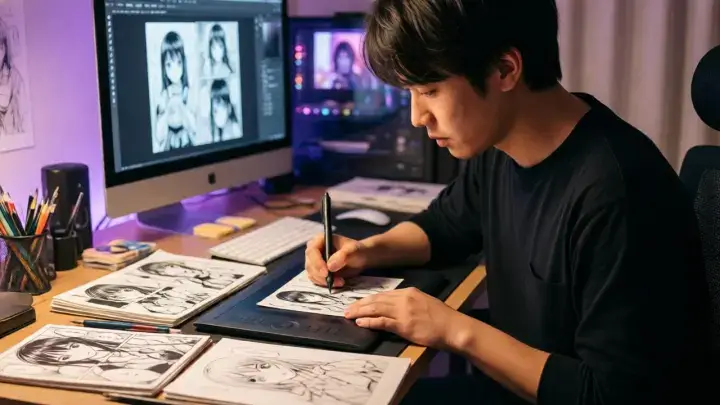
There are internet searches that lead to a person, others that lead to a company, and some that seem to lead somewhere only after the spelling itself is questioned. Doujen Moe belongs to the third category.
At first glance, the phrase looks like the name of a person, an anime character, or perhaps a specialized creative movement. Search results, however, tell a more complicated story. Some contemporary pages describe it as a meeting point between independent fan art and the emotional aesthetics associated with moe. Others connect the phrase to the older name Doujin Moe, an online property associated with doujin material. Still others treat “doujen” as an alternate spelling of the Japanese term doujin.
That uncertainty is not a minor detail. It is the most important fact about the subject.
There is no reliable evidence establishing “Doujen Moe” as the name of a specific public figure with a conventional biography, nor is there strong evidence that it is an officially recognized Japanese artistic movement. The more defensible interpretation is that the phrase exists at the intersection of several established ideas: Japanese independent creative culture, doujinshi, anime and manga fandom, the concept of moe, and the history of an online name that has circulated for years.
Understanding that distinction makes the subject considerably more interesting. Instead of forcing Doujen Moe into a biography that does not exist, it is possible to trace how the phrase is used, where its component words come from, why the spelling causes confusion, and why the name continues to attract attention.
| Fact | Details |
|---|---|
| Full Name | Doujen Moe; generally encountered as an internet phrase or name rather than an established person’s full name |
| Date of Birth | Not applicable; Doujen Moe is not reliably established as a human individual |
| Place of Birth | Not applicable; the subject is associated with online terminology and an internet-era name rather than a documented birthplace |
| Nationality | Not applicable as a personal nationality; its terminology is strongly connected with Japanese popular culture |
| Profession | Not established as a person’s profession; the phrase has been used in connection with doujin culture and an online platform/name |
| Known For | Its association with “doujin” and “moe,” as well as the historical name Doujin Moe |
| Years Active | Online references to the associated Doujin Moe domain date back to the mid-2000s; continuous activity under one identity should not be assumed |
| Net Worth | No reliable net-worth figure can be attributed to “Doujen Moe” as a person or clearly established business entity |
| Marital Status | Not applicable; no verified individual identity has been established |
| Spouse | Not applicable |
| Children | Not applicable |
| Notable Works or Achievements | No verified personal body of work; the subject’s significance lies primarily in its connection to online doujin culture, terminology, and search interest |
The First Problem Is the Name Itself
The spelling is where the story begins.
In Japanese popular culture, doujin is a well-established term. It can refer broadly to people sharing an interest or purpose and, in modern fandom contexts, to independent creative production. The related term doujinshi is much more specific: it generally refers to self-published print works, including manga, magazines, and novels.
“Doujen,” by contrast, is not the standard English romanization normally used for 同人.
That difference may seem insignificant, but it changes how the entire phrase should be interpreted.
When someone searches for Doujen Moe, they may actually be looking for information about doujin moe, doujinshi, anime fan culture, or the older online name Doujin Moe. A spelling variation can therefore create a completely different search landscape while still pointing toward overlapping subjects.
This is one reason the phrase should not automatically be presented as though it were a formal Japanese cultural category.
The distinction is especially important because a number of newer web pages confidently describe Doujen Moe as a defined creative movement. Those descriptions are understandable interpretations of the two words, but repetition on websites does not establish that the combined phrase has a recognized historical or linguistic status.
The safest approach is to separate what is established from what is inferred.
What “Doujin” Actually Brings to the Conversation
The word doujin has a much deeper history than the phrase Doujen Moe.
At its broadest, the Japanese term refers to people who share an interest, purpose, or affiliation. In popular culture, however, doujin has become strongly associated with independent creative production.
That world includes manga, literature, music, games, illustrations, and other forms of work produced outside conventional commercial channels. Some creators work independently, while others organize themselves into circles or small creative groups.
One of the most recognizable manifestations of this culture is doujinshi.
Doujinshi have become an important part of Japanese fan and independent publishing culture. They can be original creations, reinterpretations of existing characters, or works inspired by established fictional universes. Their existence illustrates something important about fandom: audiences do not merely consume popular culture. They can also respond to it by creating their own work.
The history of doujinshi is therefore broader than any single website or online phrase.
For readers wanting a broader cultural background, the established concept of doujinshi provides a much firmer foundation than the ambiguous term Doujen Moe itself.
That distinction helps put the name into perspective. Doujen Moe did not create doujin culture. At most, the phrase draws attention toward a corner of that much larger creative ecosystem.
Then There Is “Moe”
If doujin explains the independent-creation side of the phrase, moe explains its emotional side.
Moe is a Japanese slang term strongly associated with anime, manga, games, and otaku culture. It is commonly used when discussing feelings of affection or emotional attachment toward fictional characters or particular qualities those characters possess.
The idea is difficult to translate into a single English word.
“Cute” captures only part of it. “Affection” captures another part. “Endearing” gets closer in certain contexts, while “attachment” can describe the emotional dimension. Yet none of these words completely covers the range of ways moe has been used.
The concept has also developed over time.
In some contexts, moe can describe the emotional appeal of a character’s personality, behavior, appearance, vulnerability, innocence, or other defining traits. In others, it has been connected to particular character archetypes and commercial approaches within anime and manga.
That evolution has made moe a significant part of Japanese pop-cultural vocabulary.
There is a dedicated Wikipedia explanation of moe, but even that broader subject should not automatically be treated as synonymous with Doujen Moe.
The two concepts can intersect. They are not the same thing.
Why Combining the Words Creates Confusion
Put doujin and moe together and the resulting phrase sounds perfectly plausible.
A reader familiar with anime culture could reasonably interpret “doujin moe” as independently produced creative works centered around characters or themes that evoke moe. That interpretation is understandable and appears frequently in modern online writing.
The problem is that a plausible interpretation is not necessarily an established definition.
This is where Doujen Moe becomes particularly interesting as an internet phenomenon.
The phrase can be read in at least three different ways:
- as a spelling variation of “doujin moe”;
- as a reference to the historical name “Doujin Moe” associated with an online platform;
- or as a loose modern description of independent fan creativity involving moe aesthetics.
Those interpretations overlap, but they are not interchangeable.
A reader who assumes they are all the same thing can easily come away with an inaccurate understanding of the subject.
The Older “Doujin Moe” Connection
The historical online connection is perhaps the most important reason the phrase continues to appear.
Records associated with doujin-moe.com indicate a domain history reaching back to December 2005. Third-party technical records have also documented the domain at different points in more recent years.
That does not, by itself, prove uninterrupted operation, identical ownership, or an unchanged website. Domain registration is evidence of a web address existing; it is not proof that every later version of a site represents the same organization or service.
The distinction matters because some contemporary descriptions make the name sound like a newly created cultural trend, while the “Doujin Moe” name has an older internet history.
The older site association is also important because it was connected with adult-oriented doujin and anime material. That means the historical use of the name should not be casually merged with the newer, softer interpretation of the words “doujin” and “moe.”
In other words, there are two stories surrounding the phrase.
One is the story of Japanese fandom vocabulary.
The other is the story of an internet name.
They overlap linguistically, but their histories are not identical.
Why the Historical Record Matters
Internet names have a strange ability to outlive the context in which they were created.
A domain may disappear, change ownership, redirect somewhere else, or simply become less prominent. Years later, people can encounter the name through search engines without knowing its original context.
That appears relevant to Doujen Moe.
A person discovering the phrase today might naturally assume that it was coined recently to describe an artistic trend. Another person familiar with older anime-related websites might recognize it as something entirely different.
Neither searcher is necessarily acting irrationally. They are simply encountering different layers of the same online vocabulary.
This is one reason a responsible profile should resist the temptation to give Doujen Moe a single invented origin story.
There is no reliable basis for saying that one named individual created a “Doujen Moe movement,” founded a formal organization, or launched a recognized artistic school under that exact name.
The available evidence does not justify those claims.
Doujen Moe Is Not a Conventional Biography
This point deserves emphasis because the phrase itself can look like a person’s name.
There is no reliable evidence establishing a public figure named Doujen Moe whose date of birth, education, family background, career history, spouse, children, or financial record can be documented.
That means the conventional celebrity-biography approach would create a serious factual problem.
A profile that supplied a birthplace, parents, university, career milestones, net worth, or marriage history without reliable evidence would not be informative. It would simply be inventing a person.
The more useful story is therefore about the name and the culture surrounding it.
That approach also explains why the standard biography questions do not fit particularly well. There is no meaningful date of birth to provide because the subject is not established as a human individual. There is no verified spouse or family because there is no verified individual identity behind the phrase.
What can be examined is the documented history of the terminology and the internet properties associated with similar names.
The Role of Doujinshi in Understanding the Phrase
If someone encounters Doujen Moe while exploring anime and manga, understanding doujinshi is probably more useful than memorizing a supposed definition of Doujen Moe.
Doujinshi represent a form of independent publishing that gives creators space outside mainstream commercial structures.
Some works are entirely original. Others respond to existing fictional worlds.
This flexibility is one of the defining characteristics of doujin culture.
The community has historically developed its own distribution channels, conventions, circles, publishing practices, and relationships between creators and audiences. Major doujin events have become significant cultural gatherings, showing that independent fan creation is not merely a marginal internet hobby.
This background also explains why the word “doujin” carries such a strong creative association.
When combined informally with moe, it can naturally suggest character-focused independent work. But the existence of such work does not mean that “Doujen Moe” itself is a formal genre.
That distinction is subtle, yet important.
How the Internet Changes Meaning
Search culture has made this kind of linguistic confusion increasingly common.
A phrase can begin as a typo, a brand name, an abbreviated expression, or an obscure website. Once enough people search it, publishers begin writing explanatory pages around it.
Those pages can then become the evidence used by later writers.
The result is a feedback loop.
One article says the term represents an emerging movement. Another article repeats the idea. A third article adds details based on the first two. Eventually, the phrase appears to have a history because numerous pages discuss it.
But quantity is not the same as historical evidence.
Doujen Moe illustrates that problem unusually well.
Current web results contain several competing explanations. Some describe an emotional fan-art aesthetic. Others describe a creative community. Some connect it directly to doujinshi. Still others identify it with the older Doujin Moe website.
The inconsistency is itself evidence that the phrase lacks a single universally accepted interpretation.
Why the Spelling “Doujen” Keeps Appearing
There are several reasonable explanations for the unusual spelling, although none should be presented as a proven single origin.
The first possibility is simple misspelling.
Japanese words transliterated into English can produce multiple spellings, particularly when people encounter them through speech rather than writing.
The second possibility is search behavior. Once an alternate spelling becomes common enough, it can develop an identity of its own online.
The third possibility is the influence of the existing name “Doujin Moe.” Someone unfamiliar with Japanese romanization may remember or reproduce the name as “Doujen Moe.”
The fourth possibility is deliberate reinterpretation. Modern publishers may use “Doujen Moe” as a convenient label for the intersection of independent fan creation and moe aesthetics.
All four possibilities can coexist.
What cannot responsibly be claimed is that one of them has definitively been proven to be the origin of the phrase.
A Look at the Modern Fan-Culture Interpretation
Although the formal status of “Doujen Moe” is unclear, the underlying creative idea is not difficult to understand.
Independent artists have long explored characters and themes that generate strong emotional reactions. Anime and manga communities have created illustrations, comics, stories, games, music, and other works around characters they care about.
Digital platforms have made this process even easier.
An artist can create something independently, share it with a niche audience, receive immediate feedback, and develop a following without first passing through a conventional publishing structure.
That environment naturally supports the type of character-centered creativity that people may loosely describe using “doujin” and “moe” together.
The important distinction is that the creative practice is real even when the label is informal.
A fan artist does not need an official movement called Doujen Moe in order to make emotionally expressive independent work.
Where Digital Communities Fit In
Online communities have changed how doujin-inspired creativity is discovered.
In earlier periods, physical publications, specialist shops, fan circles, conventions, and personal recommendations played major roles in discovery. Today, social networks, digital marketplaces, art platforms, forums, and community sites can connect creators and audiences across national borders almost instantly.
That globalization has also changed vocabulary.
Japanese terms frequently move into international fandom communities without retaining exactly the same meaning they had in their original context.
“Manga,” “anime,” “otaku,” “doujin,” and “moe” have all traveled internationally in different ways.
As they move, meanings can broaden, narrow, or become simplified.
Doujen Moe appears to sit within that same process of linguistic adaptation.
The phrase sounds Japanese-inspired, but its modern online usage is not necessarily a reflection of standard Japanese terminology.
The Difference Between Culture and Branding
Another useful distinction is between a cultural concept and a website or brand name.
Doujin and moe are cultural terms with histories extending beyond any one website.
“Doujin Moe,” on the other hand, has also been used as an online name.
A website can borrow cultural vocabulary without becoming representative of the entire culture.
This matters because someone researching Doujen Moe might encounter descriptions of a particular website and assume that its content defines doujin culture generally.
It does not.
Doujin culture is far broader than one site, one genre, one audience, or one interpretation.
Similarly, moe is broader than any single website or publishing platform.
Keeping those layers separate produces a much clearer picture.
What Can Actually Be Said About Its “Career”?
The word career does not really apply.
If Doujen Moe is treated as the name of an internet platform or phrase rather than a person, there is no professional career in the conventional sense.
There are, however, identifiable stages in the online history surrounding the name.
The associated domain history reaches back to the mid-2000s. Later online references have continued to connect the name with doujin and adult-oriented anime material. At the same time, more recent web discussions have increasingly interpreted the phrase through the separate meanings of doujin and moe.
That is better described as an online history than a career.
It also avoids an important factual trap: confusing the history of a domain with the biography of a person.
Public Recognition Without a Public Figure
Doujen Moe demonstrates how something can become recognizable without becoming a celebrity.
A name can attract searches, articles, discussions, and curiosity even when there is no individual behind it whose biography can be documented.
The recognition comes from the phrase itself.
In this case, curiosity appears to be driven by ambiguity. People want to know whether Doujen Moe is a person, website, artistic style, fandom concept, or spelling variation.
That question creates its own momentum.
The more people encounter conflicting explanations, the more valuable a careful explanation becomes.
This may be the most significant form of “public relevance” attached to Doujen Moe today.
Why Readers Should Be Careful With Claims About the Name
The internet rewards confidence.
A page that says “Doujen Moe was founded by…” sounds more authoritative than one that says “the phrase is ambiguous.”
But when evidence is limited, confidence can become misleading.
For this subject in particular, readers should be cautious about claims involving:
- a specific founder;
- an invented birthplace;
- a supposed celebrity identity;
- a precise net worth;
- a formal artistic movement;
- an official Japanese definition;
- an uninterrupted website history;
- or personal details attributed to a person named Doujen Moe.
The available evidence does not support treating these claims as established facts.
A stronger article is one that acknowledges uncertainty where uncertainty genuinely exists.
Doujen Moe and the Broader Anime Ecosystem
Even though the phrase itself is ambiguous, the cultural territory around it is substantial.
Anime and manga fandom has produced enormous communities built around storytelling, character design, illustration, collecting, gaming, conventions, independent publishing, and online discussion.
Doujin culture occupies an important place within that ecosystem because it demonstrates how audiences can become creators.
Moe, meanwhile, illustrates how emotional reactions to fictional characters can become part of both fan discussion and commercial media.
The intersection of these ideas is therefore worth studying even if the exact phrase “Doujen Moe” remains unofficial.
In that sense, the keyword can act as a doorway.
It leads first to a spelling question, then to doujin culture, then to doujinshi, then to moe, and finally to the larger relationship between creators, fictional characters, and fandom.
What the Name Says About Internet Memory
There is also a broader cultural lesson here.
Internet history is rarely neat.
Old websites disappear. Domains change. Names are remembered incorrectly. Communities migrate. Terms acquire new meanings. Search engines preserve fragments of things that are no longer widely discussed.
Doujen Moe sits comfortably inside that messy history.
Someone discovering the term in 2026 may be encountering the remains of an older internet name while simultaneously encountering newer attempts to reinterpret it through contemporary fandom vocabulary.
That makes the phrase less like a conventional brand and more like a digital fossil.
It carries traces of several periods at once.
The Current Relevance of Doujen Moe
The continuing appearance of the phrase online does not necessarily mean that a new formal movement has emerged.
Its relevance is better understood through curiosity.
People searching for Doujen Moe may be trying to identify a website, understand a spelling, learn about doujin culture, investigate the meaning of moe, or locate a particular type of anime-related material.
Those different motivations explain why the search landscape remains fragmented.
Rather than asking, “What single thing is Doujen Moe?” it is more useful to ask, “Which meaning of Doujen Moe is being used here?”
That small change in perspective resolves much of the confusion.
Frequently Asked Questions About Doujen Moe
Is Doujen Moe a person?
There is no reliable evidence establishing Doujen Moe as a specific public person with a documented biography. The phrase is better understood as an internet-related name or search term connected with doujin and moe-related subjects.
What does Doujen Moe mean?
There is no universally established definition. “Doujen” appears to be a variant or mistaken spelling associated with doujin, while “moe” is an established Japanese fandom term associated with emotional affection toward fictional characters and character traits.
Is Doujen Moe the same as Doujin Moe?
The two names are closely related in online usage, but they should not automatically be treated as identical. “Doujin Moe” has a documented history as an online name, while “Doujen Moe” is also used as a broader or alternative spelling in modern web discussions.
Is Doujen Moe an official Japanese genre?
There is insufficient evidence to describe it as an officially recognized Japanese genre or established artistic movement. Contemporary websites sometimes use the phrase that way, but the underlying terminology is more securely connected to the separate concepts of doujin and moe.
What is doujin?
Doujin is a Japanese term associated broadly with people sharing interests or purposes and, in popular culture, with independent creative activity. The wider doujin world includes manga, literature, music, games, illustrations, and other works.
What is doujinshi?
Doujinshi are self-published works, commonly including manga, magazines, and novels. They can be original or based on existing fictional properties. Doujinshi form one of the best-known parts of Japanese independent publishing culture.
What does moe mean in anime culture?
Moe describes a strong emotional response or affection toward fictional characters or qualities associated with them. The precise meaning can vary according to context, and it has developed significantly within anime, manga, game, and otaku culture.
Is Doujen Moe a website?
The closely related name “Doujin Moe” has historically been associated with an online website. Domain records for doujin-moe.com date back to 2005. However, domain history alone does not establish that every version of the website over time had the same ownership, content, or operation.
Who founded Doujen Moe?
No founder can be reliably attributed to “Doujen Moe” as a phrase. Some third-party sources make claims about people associated with the historical Doujin Moe name, but the available evidence is not sufficiently consistent to present a personal founder biography as established fact.
Does Doujen Moe have a known net worth?
No reliable net-worth figure can be attributed to Doujen Moe. The subject is not established as a conventional person or clearly documented corporate entity for which a trustworthy public valuation can be given.
Is Doujen Moe the same thing as anime fan art?
Not exactly. Anime fan art is a broad category. Doujin culture includes many forms of independent creative work, while moe refers to an emotional or aesthetic concept. “Doujen Moe” may be used informally to describe an overlap between those ideas, but it is not a precise synonym for fan art.
Why do people spell doujin as doujen?
The exact reason is uncertain. “Doujin” is the more established romanization, while “doujen” appears as an alternative spelling online. It may result from transliteration differences, memory, branding, or ordinary internet spelling variation.
Is Doujen Moe an established cultural movement?
There is not enough reliable evidence to make that claim. The phrase has been described as a movement by some recent online articles, but its status as a formal or widely recognized Japanese cultural movement is not established.
Why does Doujen Moe keep appearing in searches?
The phrase combines familiar fandom vocabulary with an older online name, creating multiple possible search intentions. People may be looking for information about doujin culture, moe, doujinshi, or the historical Doujin Moe website.
A Better Way to Understand the Phrase
The temptation with an unusual search term is to look for one definitive answer.
Doujen Moe resists that approach.
The most accurate explanation is not that it represents one famous person or one universally recognized cultural movement. Instead, it occupies a crossroads between established Japanese fandom terminology and an older internet identity.
The spelling “doujen” contributes to the confusion. The word doujin has a genuine cultural history, while moe has its own distinct meaning and development. The combination can therefore appear meaningful even when the exact phrase has no standardized definition.
The historical Doujin Moe name adds another layer, because it has been associated with an online platform whose history predates many of the newer articles discussing “Doujen Moe.”
Taken together, these details explain why the term can produce such dramatically different search results.
Why the Ambiguity Is the Story
For many subjects, uncertainty weakens an article.
Here, uncertainty is the story.
Doujen Moe demonstrates how digital culture can create a strange mixture of language, branding, fandom, memory, and search behavior. A spelling variation can become a search phrase. A website name can be reinterpreted as a cultural concept. A genuine Japanese word can be combined with another established term and produce a phrase that sounds official even when its status remains unclear.
That process is increasingly common in online culture.
It also offers a useful reminder: not every popular search phrase corresponds to a person, company, genre, or movement.
Sometimes the most accurate answer is the one that carefully separates the pieces.
For readers interested in wider contemporary culture, anime, digital communities, and unusual internet phenomena, publications such as VogueMag can provide a broader editorial context for the kinds of online trends and cultural subjects that frequently cross between niche communities and mainstream curiosity.
Where Doujen Moe Fits in the Bigger Picture
Ultimately, Doujen Moe is less important as a supposed biography than as a window into the way internet culture evolves.
The underlying world of doujin creativity is real and historically significant. Doujinshi have provided independent creators with a way to publish and share work outside traditional channels. Moe is an established concept within Japanese popular culture and has influenced the way audiences discuss character appeal and emotional attachment.
The phrase Doujen Moe appears to borrow from that vocabulary while also carrying the legacy of the older Doujin Moe name.
That combination is enough to explain its continuing curiosity.
There is no need to invent a childhood, education, marriage, fortune, or celebrity career for a subject that does not have those reliably documented attributes. The more compelling story is already there: a peculiar name, an evolving fandom vocabulary, an old internet footprint, and a modern search culture that keeps trying to decide what the phrase means.
In the end, Doujen Moe is best understood not as a conventional person but as an ambiguous piece of internet language—one that points toward the much larger worlds of doujin creation, anime and manga fandom, moe culture, and the unpredictable afterlife of old web identities.
For More Visits: Voguemag

