
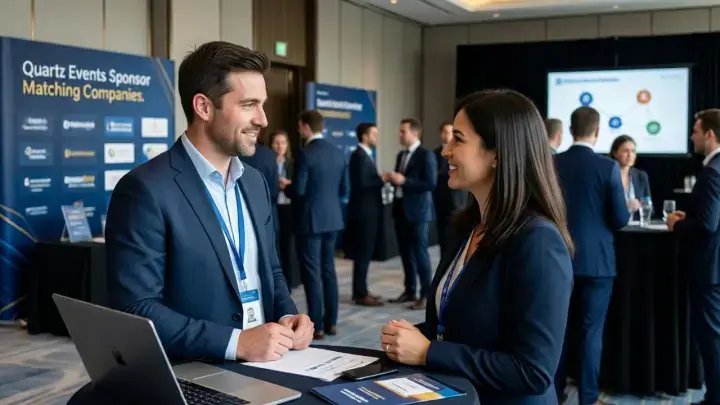
Quartz Events Sponsor Matching Companies: Inside the B2B Matchmaking Model
Walk into a large business conference and one thing becomes obvious almost immediately: a crowded room does not necessarily mean a productive room.
Hundreds of badges can swing from lanyards. Booths can be covered with polished branding. Sales teams can spend an entire day introducing themselves to people who are curious but have no purchasing responsibility, no immediate project and no reason to continue the conversation after the event. For a company selling a complex B2B product, that can be an expensive way to discover that attendance and relevance are two very different things.
That tension helps explain the growing interest in quartz events sponsor matching companies. The phrase can initially sound as though it describes a directory of businesses that find sponsors for conferences. The more useful way to understand it is as a meeting-based B2B event model associated with Quartz Network, where solution providers and senior business decision-makers are brought together through a more structured process.
Instead of leaving every introduction to chance, the model puts considerable attention on who needs what, which business problems are being investigated, and whether a particular solution provider has a credible reason to be in the conversation. Quartz’s sponsorship materials describe one-to-one meetings, advance prospect information and the ability for sponsors to identify attendees they want to meet.
That distinction changes the entire character of event sponsorship. The sponsor is not simply buying visibility. The company is buying access to a carefully organized set of business conversations.
| Fact | Details |
|---|---|
| Topic Name | Quartz events sponsor matching companies |
| Industry | B2B events, executive networking and business development |
| Category | Meeting-based event sponsorship |
| Primary Purpose | Connect solution providers with relevant business decision-makers |
| Related Events | CONNECT CMO, CONNECT CFO, CONNECT HR, VISIONS and SCOPE programs |
| Main Participants | Senior executives, solution providers, sponsors and event organizers |
| Business Model | Sponsored access to curated, qualified business meetings and networking |
| Geographic Focus | Primarily North America and the UK/EMEA event markets |
| Key Functions | Audience qualification, prospect matching, one-to-one meetings and networking |
| Current Relevance | Particularly useful for companies selling complex B2B products and services |
Why Sponsor Matching Became More Interesting
Traditional sponsorship has never been only about selling a booth. Even decades ago, companies understood that an event was valuable because of the people gathered around it. The booth, logo placement and speaking opportunity were mechanisms for getting closer to those people.
But the scale of modern B2B events has created a problem. More attendees do not automatically make prospecting easier.
A technology company might have a product designed for chief information officers, yet spend much of a general conference speaking with junior employees, vendors, students or professionals who simply stopped because the booth looked interesting. A financial software company may need a CFO with a specific transformation project, not a room full of people who happen to work in finance. An HR technology provider might be looking for an organization actively reviewing talent-management systems rather than an executive who has no current plans to change anything.
The difference is subtle but commercially important.
A conventional event asks a sponsor to find opportunity inside an audience.
A sponsor-matching model attempts to bring opportunity closer to the sponsor.
That is why the phrase quartz events sponsor matching companies is better understood through the lens of business matchmaking rather than conventional event advertising. It sits somewhere between an executive summit, a sales-development environment and a highly organized networking experience.
The broader idea fits within the history of event marketing, where events can function not merely as gatherings but as environments for direct interaction between organizations and prospective customers.
Quartz takes that basic idea and places much greater emphasis on structured meetings.
Quartz Network and the Evolution of the Model
The Quartz story is also useful because it shows how the event business has changed.
Quartz Events was established around executive-focused gatherings rather than giant public exhibitions. Its emphasis was on bringing senior business professionals together in more targeted environments. In 2020, Clarion Events announced that it had acquired Quartz Events, describing it as a producer of invitation-only executive summits and noting its ability to operate both physical and virtual programs.
That history matters because the Quartz approach was never simply about creating another exhibition hall.
The underlying proposition was narrower: identify executives who matter to a particular business function, create an environment where they can exchange ideas, and give solution providers a practical route into conversations with those executives.
Over time, the portfolio has covered different corporate functions. Current sponsorship materials include programs associated with marketing, finance, human resources, information technology, supply chain and procurement, among other areas.
That specialization is one of the model’s most important characteristics.
A general business conference can offer enormous reach. A specialized executive event offers something different: context.
When everyone in the room is concerned with similar categories of problems, a sponsor does not have to spend the first ten minutes explaining why the issue matters. The discussion can begin closer to the actual business question.
What “Quartz Events Sponsor Matching Companies” Really Means
The wording itself creates some confusion.
Quartz events sponsor matching companies is not best treated as the formal name of a separate industry category. It is more useful as a description of companies that participate in, or are interested in, Quartz’s sponsor-to-executive matching environment.
There are three important sides to the model.
First is the event and network operator, which organizes the audience, event experience and matching process.
Second are the executive attendees. These are business leaders participating because they have professional interests, projects, responsibilities or problems that can benefit from discussion with peers and potential solution providers.
Third are sponsors and solution providers. These companies have products, services, technology platforms, consulting expertise or other business offerings that may address those needs.
The interaction among these three groups is what gives the model its shape.
The sponsor does not simply say, “We want exposure to executives.”
Instead, the more useful question becomes, “Which executives are relevant to what we sell, and what are they actually working on?”
That is a very different starting point.
How the Matching Process Works
At its core, sponsor matching is about reducing irrelevant conversations.
The process can be thought of as a sequence of decisions rather than a single matchmaking moment.
First Comes Audience Qualification
The quality of a matching system depends heavily on the quality of its audience.
If almost anyone can attend an event, the organizer may have a large registration number but limited information about whether individual attendees are useful prospects for a particular sponsor.
Quartz’s current sponsorship materials emphasize invitation-only participation and attendee vetting. Its event pages describe audiences organized around specific business functions and responsibilities.
That qualification creates the foundation for everything that follows.
The goal is not simply to know that someone works at a company. A sponsor needs to know whether that person’s responsibilities intersect with the problem it solves.
Then Comes the Business Need
Job title alone is rarely enough.
Two people with nearly identical titles can have completely different priorities. One may be preparing a major technology transformation. Another may be maintaining an existing system. One may have an active procurement project. Another may have no budget available for several years.
Matching becomes more meaningful when the organizer can distinguish those situations.
Quartz’s sponsorship proposition centers on providing information about prospective customers before meetings, allowing sponsors to prepare rather than walk into every conversation blind.
This is where the concept moves beyond ordinary networking.
The conversation becomes less about discovering whether a person is relevant and more about understanding whether the proposed solution fits a known business situation.
Sponsors Can Shape Their Meeting Schedule
Another important part of the model is sponsor choice.
Quartz states that sponsors know who is attending ahead of time and can handpick people they want to meet. The attendees selected for meetings are also informed in advance.
That creates a two-sided expectation.
The sponsor has a reason to prepare.
The executive has a reason to participate.
Neither side is supposed to be discovering the purpose of the meeting for the first time after sitting down.
This does not guarantee that a conversation will become a sale. It does, however, make the opening conversation potentially more relevant.
Why One-to-One Meetings Matter
The strongest argument for sponsor matching is not that meetings are inherently better than booths. It is that certain B2B products are difficult to sell through casual interactions.
Consider enterprise software.
A software vendor cannot realistically explain its complete value proposition in a thirty-second hallway conversation. The buyer may have questions about integration, security, implementation, cost, internal adoption and compatibility with existing systems.
The same applies to consulting.
A consulting firm may be capable of solving a particular operational problem, but the buyer needs to explain the organization, its constraints and what has already been attempted.
A one-to-one conversation provides more room for those details.
The importance of personal relationships in B2B commerce is hardly new. Business-to-business activity is fundamentally different from selling a low-cost consumer item because purchases often involve organizations, multiple stakeholders, specialized requirements and longer decision processes.
The meeting-based model recognizes that reality.
It does not attempt to compress every business relationship into a booth visit.
Which Companies Are Most Likely to Benefit?
Not every company needs this type of event.
A business selling inexpensive consumer products may gain more from mass exposure, retail distribution or consumer-facing campaigns. A local company may care more about geographic visibility. A startup with no defined sales process may struggle to make use of a large number of executive meetings.
The model is more naturally suited to companies with a clearly defined B2B audience.
Technology Providers
Technology companies are an obvious fit because many sell directly into specific corporate departments.
A cybersecurity company may want security leaders.
A cloud provider may want technology executives.
A data platform may want analytics or information leaders.
An enterprise software company may want executives responsible for transformation or operations.
Quartz’s technology-focused VISIONS sponsorship materials, for example, organize relevant areas around subjects such as cloud, business intelligence, data security, analytics, compliance and infrastructure.
The value is not merely having technology buyers in the room. It is having the right kind of technology buyer.
Marketing Companies
Marketing technology has become complicated enough that specialization matters.
A company selling customer-experience software does not necessarily want the same audience as a company selling advertising technology. A brand strategy consultancy may need different conversations from a demand-generation platform.
Quartz’s marketing sponsorship materials identify responsibilities spanning areas such as customer experience, demand generation, marketing technology, analytics, brand and communications.
That breadth gives sponsors multiple possible entry points while still keeping the event centered on marketing leadership.
Finance Solutions
Finance departments have their own ecosystem of software, services and professional expertise.
ERP providers, financial technology businesses, compliance specialists, consulting firms, analytics companies and other vendors can all face the same fundamental challenge: reaching the person who can evaluate the solution.
Quartz’s finance program describes responsibilities including budgeting and forecasting, compliance, financial reporting, ERP software, risk management, procurement and professional services.
For a sponsor, that kind of environment can be more meaningful than a generic executive conference.
Human Resources Providers
HR technology is another field where buyer relevance matters.
A company selling recruiting technology needs different conversations from a provider focused on employee engagement. A benefits company may need access to different decision-makers than a leadership-development consultancy.
Quartz’s HR sponsorship materials include areas such as recruiting, talent management, learning, leadership development, benefits, compensation, engagement and employee experience.
Again, the central idea is specificity.
The Difference Between a Lead and a Conversation
One of the most useful ways to understand sponsor matching is to separate lead volume from conversation quality.
A company can collect hundreds of names and still have no meaningful sales pipeline.
A badge scan does not tell a sales representative whether the person has a problem, authority, budget or timeline.
A business conversation can be much more revealing.
A senior executive may explain that a major project is already approved but the vendor selection process has not begun. Another may say that the problem exists but funding is unavailable. A third may explain that the organization is satisfied with its current provider.
All three conversations are useful because they provide context.
Not every useful meeting produces a sale.
Sometimes the value of a meeting is learning that a prospect is not ready.
Sometimes it is discovering who else needs to be involved.
Sometimes it is understanding how a buyer thinks about a problem.
And sometimes it is the beginning of a commercial relationship.
The important difference is that the conversation produces information that a logo impression never can.
What Sponsors Need to Prepare Before an Event
Sponsor matching does not remove the responsibility from the sponsor. It changes where that responsibility begins.
If a company knows in advance who it will meet, there is little excuse for arriving with a generic pitch.
Preparation should start with the prospect’s organization.
What does the company do? What kind of operational environment might it have? What problems could plausibly be relevant? What questions should be asked before presenting a solution?
The next step is understanding the individual.
What is the executive responsible for? Is the person a potential buyer, an influencer, a technical evaluator or simply someone with knowledge of the problem?
Then comes the hardest part: knowing when not to sell.
A strong meeting is often a diagnostic conversation before it becomes a sales presentation.
The sponsor’s representative should be able to say, in effect, “Tell me what is happening inside your organization,” and then listen.
That is particularly important when the event provides prospect information in advance. Quartz explicitly positions advance information as a way for sponsors to enter meetings better prepared.
Preparation only creates an advantage if the sales team actually uses it.
Why the Model Can Be Attractive to Senior Executives
The sponsor is not the only party that needs to gain something.
An executive attending a meeting-based event has little reason to spend valuable time with a company that has nothing relevant to offer.
That is why matching must work from both directions.
The executive should have an opportunity to investigate potential solutions, compare approaches and ask questions without immediately committing to a purchase.
The sponsor gets an opportunity to explain its capabilities to someone who has already been identified as potentially relevant.
The event organizer sits between the two, attempting to create enough structure that both sides find the experience useful.
That is also why executive qualification matters so much. A meeting with a senior decision-maker can be valuable, but only if the subject of the meeting is actually relevant to that executive’s responsibilities.
Quartz Events Compared With a Traditional Trade Show
The easiest comparison is not “old versus new.” Both models can be useful.
A traditional trade show tends to maximize physical presence.
There may be exhibition booths, large displays, demonstrations, product launches, presentations and a constant flow of people.
That environment can be excellent for visibility.
A company trying to introduce itself to an entire industry may value the opportunity to be physically present where thousands of professionals gather.
Sponsor matching has a different emphasis.
The central unit is the meeting.
A sponsor is not primarily asking, “How many people walked past our stand?”
The question becomes, “How many relevant conversations did our team have, and what did those conversations reveal?”
That distinction affects everything from staffing to measurement.
A booth can benefit from charisma, location and visual presentation. A meeting-based event benefits from preparation, qualification and sales discipline.
Neither approach is automatically superior.
The right choice depends on the business model.
The Economics Behind the Attraction
The financial logic becomes clearer when the sales process is expensive.
Suppose a company sells a high-value enterprise product. Its sales team may spend weeks researching accounts, contacting prospects, arranging calls and conducting demonstrations.
If an event can compress part of that process by putting qualified executives into scheduled conversations, the event may have a different economic value from a standard sponsorship package.
The calculation is not simply the price of attendance.
A serious sponsor should consider the complete cost:
- Sponsorship fees
- Travel and accommodation where relevant
- Staff time
- Pre-event preparation
- Follow-up resources
- Sales-development costs
- Demonstration or presentation materials
- Opportunity cost
Then the company should compare those expenses with the actual commercial outcomes.
This is where guaranteed meeting volume can become relevant. Quartz currently advertises sponsorship packages with guaranteed qualified meetings, with the number depending on the package.
But “guaranteed meeting” should never be confused with “guaranteed customer.”
That distinction is fundamental.
A meeting is an opportunity.
The product still has to fit. The buyer still has to care. Budget still matters. Timing still matters. Competitors may be involved. Internal approvals may slow everything down.
The event can create the introduction, but it cannot force the commercial decision.
What Makes a Match Good?
A good match is more complicated than a job title.
Imagine a company selling procurement software.
An executive responsible for procurement may look ideal on paper. But if the company recently completed a major procurement-platform migration and has no plans to change systems, the match may be weak.
Now imagine another executive with the same title who is actively examining supplier visibility, automation and purchasing workflows.
That second meeting has a much stronger commercial reason to exist.
The difference is intent.
Strong matching therefore depends on several dimensions working together:
Role
Does the person’s professional responsibility connect to the solution?
Problem
Does the organization have a problem the sponsor can realistically address?
Timing
Is the issue active now, or is it merely a theoretical future concern?
Authority
Can the person influence the purchase or bring the right decision-makers into the process?
Fit
Does the sponsor’s solution actually suit the organization’s environment?
The more of these elements line up, the more useful the meeting is likely to become.
The Role of Specialization
Specialized events have another advantage: vocabulary.
A marketing executive and a cybersecurity executive can both be senior decision-makers, but they live in different professional worlds.
Their problems, budgets, technology environments and vendor landscapes can be completely different.
This is why Quartz’s separate event families matter. Programs built around finance, HR, marketing, information technology and supply chain are not simply different names attached to the same conference concept. Their audiences are connected to distinct corporate responsibilities.
For sponsors, that can make targeting more practical.
Instead of trying to appeal to everyone, the company can build its message around the language and problems of one professional group.
Supply Chain Shows Why Matching Matters
Supply chain is an especially clear example.
A company may sell warehouse-management technology, transportation software, forecasting tools, procurement platforms or logistics services. Each solution touches a different part of the supply chain.
Quartz’s SCOPE sponsorship materials identify areas including demand planning, inventory management, procurement, transportation management, warehouse management, systems integration and logistics services.
That creates a broad but still coherent commercial environment.
The sponsor can identify which areas are closest to its product rather than entering a general-purpose business conference and hoping that someone happens to need its service.
The Limits of Matching
Matching is powerful, but it is not magic.
Data can be incomplete.
A prospect can describe a project that later gets postponed.
An executive may be interested in a solution but lack the authority to purchase it.
A sponsor can misunderstand the problem.
Two companies may appear perfectly aligned until the first meeting reveals that their technologies cannot integrate.
And even an excellent conversation may lead nowhere because corporate priorities change.
There is another limitation that is easy to overlook: overqualification can sometimes become its own problem.
If a sponsor becomes so focused on finding the “perfect” prospect that it ignores adjacent opportunities, it may miss valuable relationships.
A good event should leave room for discovery.
Not every important relationship can be predicted by a form.
The Human Element Still Matters
Technology can identify patterns, organize information and help structure meetings, but business relationships remain human.
An executive may choose a vendor because the salesperson understands the problem unusually well. Another may respond to technical credibility. Someone else may care about implementation support or the confidence that the provider will remain available after the contract is signed.
Those things are difficult to reduce to matching criteria.
This is why the best interpretation of sponsor matching is not automated matchmaking.
It is structured matchmaking.
The structure gets the right people into the room.
The people determine what happens next.
From Event Day to the Follow-Up Period
The event itself may last only a short time. The commercial process can continue for months.
This is where some sponsors lose the benefit of the model.
A carefully arranged meeting is only the opening.
The sales team needs to document what happened, identify the strongest opportunities, send relevant follow-up information and establish the next step while the conversation is still fresh.
A generic “great meeting you” email wastes much of the advantage created by the event.
The follow-up should reflect the discussion.
If the executive described a specific operational problem, the response should address that problem. If the executive asked for technical material, send the technical material. If the buyer needs to involve another department, help create that next conversation.
The quality of follow-up often determines whether a meeting becomes an opportunity or simply becomes another entry in a CRM.
What Companies Should Ask Before Sponsoring
A company considering Quartz events sponsor matching should not evaluate an event solely on the promise of meetings.
It should ask practical questions.
Who exactly will attend?
What seniority levels are represented?
How are attendees qualified?
How are meetings selected?
What information will the sponsor receive before the event?
What counts as a qualified meeting?
How are cancellations handled?
What happens if a meeting is not a fit?
Which departments and responsibilities are represented?
How closely does the audience resemble the company’s actual customer profile?
And perhaps most importantly: what does success look like after the event?
These questions force a company to move beyond excitement and into commercial planning.
Where the Model Fits in the Larger B2B Landscape
The rise of meeting-based events reflects a larger shift in how companies think about business development.
Digital communication has made it easier to reach almost anyone. That has also made it harder to earn attention.
Executives receive emails, social messages, invitations and sales pitches throughout the day. A message can be perfectly written and still disappear.
Physical and virtual executive events offer a different environment because the participant has already agreed to spend time engaging with a specific professional community.
The challenge then becomes quality.
A company does not need another channel simply for the sake of having another channel. It needs a channel that reaches the people who matter.
That is why the sponsor-matching model has remained attractive even as business networking has become increasingly digital.
The point is not to replace digital communication.
It is to create situations where digital communication can lead to a more meaningful human conversation.
What the Future Could Look Like
The future of sponsor matching is unlikely to be about simply scheduling more meetings.
Quantity has obvious limits.
If an executive spends an entire event moving from one sales conversation to another, the experience quickly becomes exhausting. Sponsors face the opposite problem: too many meetings can reduce preparation quality and make conversations feel rushed.
The next stage of the model is therefore likely to revolve around relevance.
Better understanding of business priorities can improve matching. More precise information about projects can make meetings more useful. Better pre-event preparation can help sponsors ask more intelligent questions.
There is also room for more continuity between events.
A relationship does not necessarily need to begin and end at a summit. If an executive is researching a solution over several months, the value of a business network can extend beyond a single meeting.
This broader idea is already visible in Quartz’s positioning around both events and solution connections. Its sponsorship materials describe event-based meetings alongside other ways of connecting solution providers and executives.
The underlying principle is simple: the most valuable business relationship may not fit neatly inside a two-day event.
Why the Phrase Matters Beyond Quartz
The real significance of quartz events sponsor matching companies may be larger than the specific phrase itself.
It represents a change in what companies increasingly expect from sponsorship.
For years, sponsorship was often evaluated through visibility: logo placement, booth size, speaking slots, attendee counts and brand exposure.
Those things still matter.
But B2B buyers and sellers increasingly want evidence that an event can create actual business conversations.
That puts pressure on organizers to know their audiences better.
It also puts pressure on sponsors to know themselves better.
A company cannot benefit from precise matchmaking if it does not know who its ideal customer is. It cannot take advantage of executive meetings if its sales team cannot explain its value clearly. And it cannot measure event success if it has no definition of what a successful opportunity looks like.
Sponsor matching therefore works in both directions.
The organizer must understand the audience.
The sponsor must understand the buyer.
The meeting happens where those two understandings overlap.
The Takeaway: Relevance Is the Real Product
The most interesting thing about Quartz’s model is not the meeting schedule itself.
It is the attempt to remove randomness from business networking.
A traditional event says, in effect, “Here is a room full of people. Find the right ones.”
A matching-based event says, “Here are people whose professional responsibilities and current interests may be relevant to what you offer. Start there.”
That does not eliminate uncertainty. No event can guarantee that a conversation will become a contract.
What it can do is improve the starting conditions.
For a company selling sophisticated software, consulting, financial services, HR technology, cybersecurity, marketing technology or supply-chain solutions, that difference can be significant. The value of an event is not ultimately measured by how busy the room looks. It is measured by whether the right people have a reason to continue talking after the introductions are over.
That is the central idea behind quartz events sponsor matching companies: the most valuable event connection is rarely the person who happens to walk past. It is the person who has a relevant problem, the authority to discuss it and a reason to keep the conversation going.
And in an environment where executive attention is increasingly difficult to earn, relevance may be the most valuable thing an event can offer.
Frequently Asked Questions
What are Quartz events sponsor matching companies?
The phrase generally refers to the sponsor-matching and meeting-based model associated with Quartz Network. It describes an environment where B2B solution providers are connected with relevant business executives through curated meetings rather than relying entirely on general networking or booth traffic.
How does Quartz match sponsors with executives?
The model uses information about executive responsibilities, interests and business needs to identify potentially relevant conversations. Sponsors can receive information about prospective attendees and select people they would like to meet, according to Quartz’s sponsorship materials.
What types of businesses can benefit from Quartz events?
The model is particularly relevant to B2B companies selling specialized products and services, including technology providers, consultants, financial solutions, HR technology, marketing platforms, cybersecurity businesses and supply-chain providers.
Are Quartz events the same as traditional trade shows?
No. Traditional trade shows often place greater emphasis on exhibition space, branding, product demonstrations and general attendee traffic. Quartz’s sponsorship model puts greater emphasis on qualified one-to-one meetings and structured connections with relevant executives.
Does a sponsor meeting guarantee a sale?
No. A scheduled or qualified meeting creates a sales opportunity, not a guaranteed customer. Product fit, budget, timing, authority, competition and follow-up can all determine what happens after the meeting.
Why is audience qualification important?
A large audience is not automatically a useful audience. Qualification helps sponsors focus on people whose responsibilities and business challenges may actually relate to their products or services.
Which Quartz programs cover major business functions?
Quartz’s current sponsorship portfolio includes programs focused on areas such as marketing, finance, HR, information technology, data strategy and analytics, and supply chain and procurement.
What should a company consider before sponsoring?
A potential sponsor should examine the actual audience, attendee seniority, qualification process, meeting criteria, prospect information, expected follow-up workload and how closely the event matches its ideal customer profile. The most important question is whether the meetings are commercially relevant, not simply how many meetings are offered.
For More Visits: Voguemag

