
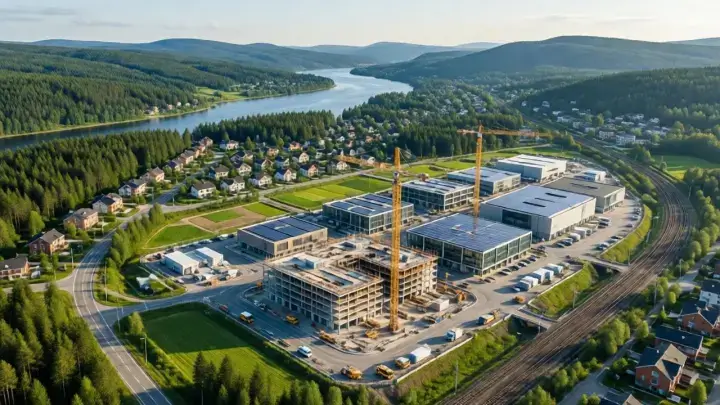
The word Bodenxt can look like the name of a company, a software platform, or perhaps a new technology product. It is none of those things in its official Swedish context. Bodenxt is the name used by the Municipality of Boden for the platform and organized effort surrounding the town’s extraordinary period of industrial and social transformation in northern Sweden.
That distinction becomes important when the name appears alongside stories about green steel, new housing, railways, employment, renewable energy, or people moving north for work. Bodenxt sits at the intersection of all of those subjects. It is not the steel plant itself, nor is it another name for Stegra, the company developing the major green-steel project in Boden. Instead, it is the broader municipal framework for managing the consequences and opportunities created by rapid change.
Boden, a town in Norrbotten County, has long had a distinctive position in northern Sweden. Its railway connections, military history, surrounding natural resources, and proximity to the larger Luleå region have shaped its development for generations. Today, however, the town is entering a very different chapter. Industrial investment is accelerating, new residents are arriving, infrastructure is being expanded, and the municipality is trying to ensure that economic growth is accompanied by homes, skills, services, businesses, and functioning communities.
Bodenxt is the name attached to that wider challenge.
| FactDetails | |
|---|---|
| Full Name | Bodenxt |
| Date of Birth | Not applicable; Bodenxt is a municipal development platform, not a person |
| Place of Birth | Boden, Norrbotten County, Sweden |
| Nationality | Swedish municipal initiative |
| Profession | Community development and green-transition platform |
| Known For | Coordinating and communicating Boden’s major green industrial and societal transformation |
| Years Active | Launched publicly as a dedicated platform in 2021; municipal work under the framework developed further from 2022 onward |
| Net Worth | Not applicable |
| Marital Status | Not applicable |
| Spouse | Not applicable |
| Children | Not applicable |
| Notable Works / Achievements | Supporting work across skills supply, living and housing, business development, and infrastructure as Boden undergoes rapid transformation |
What Bodenxt Actually Means
The simplest way to understand Bodenxt is to stop thinking of it as a single project.
The Municipality of Boden describes Bodenxt as the platform for the community’s major green transition. Its purpose is to bring together different areas of municipal development while Boden experiences a pace of change that the municipality compares with roughly two decades of development occurring within a much shorter period.
That is a much broader mission than constructing an industrial facility.
A new factory can be built on a designated piece of land. A town cannot be transformed so neatly. When a major industrial project brings new workers, contractors, families, investment, suppliers, and visitors, the effects spread into almost every part of everyday life.
People need somewhere to live.
Children need schools and preschools.
Workers need transportation.
Businesses need customers and employees.
The municipality needs water, wastewater, electricity, roads and other infrastructure.
Newcomers need ways to become part of the community.
Existing residents need to feel that growth improves rather than disrupts their lives.
Bodenxt exists within that larger picture.
The municipality has organized its work around areas including skills supply, living and housing, business development, and infrastructure above and below ground. Earlier municipal documentation similarly describes four core development areas, while the current Bodenxt presentation groups infrastructure work into above- and below-ground dimensions.
The result is less like a conventional project and more like a coordinating framework for a town preparing for a new economic era.
Why Boden Became the Setting
To understand Bodenxt, it helps to understand Boden itself.
Boden is located in northern Sweden, in Norrbotten County. The town developed strongly around transportation and military functions. Its railway history is particularly important: Boden became a significant junction connecting the northern railway system, while its strategic location also contributed to the development of the Boden Fortress and Sweden’s military presence in the area.
That history created an unusual combination of characteristics.
Boden is not simply an isolated northern settlement. It sits within a regional network that includes Luleå and the wider industrial landscape of Norrbotten. It has access to transportation infrastructure, renewable electricity resources and the industrial traditions of northern Sweden.
Those characteristics have become increasingly relevant as Europe looks for ways to reduce industrial emissions.
The new generation of green industrial projects depends on more than the availability of land. Electricity, transportation, raw materials, skilled workers, digital connectivity, water systems and logistics all matter. Northern Sweden has attracted major attention because several of those ingredients come together in the region.
Boden therefore finds itself at a particularly interesting intersection: a town with an established identity being asked to accommodate a new industrial future.
Bodenxt is the municipal response to that situation.
For broader background on the place itself, readers can also explore the history of Boden alongside the municipality’s development story.
The Green Steel Connection
One name appears repeatedly whenever Bodenxt is discussed: Stegra.
Stegra is building a large green-steel facility in Boden Industrial Park. Bodenxt and Stegra are connected, but they are not the same thing.
This distinction is essential.
Stegra is an industrial company and the green-steel project is its industrial investment. Bodenxt is the municipal platform concerned with the broader transformation of Boden.
The scale of the industrial project helps explain why the municipality needed a wider framework.
According to Boden Municipality, the industrial park covers approximately 550 hectares. The municipality says the site offers access to renewable electricity and existing infrastructure and is intended to support land-intensive industries involved in the green transition. The Stegra facility is expected to use hydrogen-based production technology and is described by the municipality as the world’s first full-scale green-steel plant.
The industrial development therefore creates opportunities well beyond the factory gates.
Suppliers can emerge.
Restaurants can gain customers.
Construction companies can expand.
Accommodation can become more valuable.
Workers can relocate.
Families can arrive.
Educational institutions can adapt programs.
Transport networks can require upgrades.
That chain reaction is precisely why Bodenxt cannot be understood simply by looking at steel production.
A Town Preparing for More People
Perhaps the most human part of Bodenxt is housing.
Industrial announcements often focus on investment figures, construction schedules and production capacity. Municipal transformation is different. Eventually, every economic statistic becomes a question about where people will live.
Boden has been preparing for population growth connected to the industrial transition. The municipality has specifically identified housing as a central challenge and has reported construction activity alongside the expected arrival of new workers and families.
This creates an unusual planning problem.
Building homes takes time. Recruiting workers can happen much faster.
A company may know that it needs specialists months or years before enough suitable housing exists. People moving internationally may need rental accommodation, schools, childcare and information about everyday life. Existing residents may also be affected by changing property markets and increased demand.
Bodenxt therefore treats living and housing as a central component rather than an afterthought.
The question is not simply how many apartments can be built.
It is what kind of community people will find when they arrive.
That distinction matters. A successful industrial transition requires people to do more than accept jobs. They need to establish lives.
Skills Are Part of the Infrastructure
A modern industrial transformation cannot be built entirely from concrete and steel.
It also requires people.
Bodenxt places skills supply among its major areas of work because industrial expansion creates demand for engineers, technicians, construction workers, operators, service employees, managers and specialists. The municipality has worked with employers and educational institutions to address emerging workforce requirements.
The skills question is more complicated than simply advertising vacancies.
Some positions can potentially be filled by people already living in the region. Others may require recruitment from elsewhere in Sweden or internationally. Some skills may need to be developed through education and training.
This is why municipal workforce planning increasingly overlaps with relocation services.
Someone considering a move to Boden is not only asking whether a job exists.
They may also ask:
- What housing is available?
- What schools are nearby?
- What is daily life like?
- Can a partner find employment?
- What services are available?
- How easy is transportation?
- What does the community offer outside working hours?
Bodenxt’s broader communications work reflects that reality.
The transformation is about attracting people who can contribute to the region while also creating conditions in which those people can establish lasting lives there.
Business Growth Beyond the Factory
A large industrial project rarely stays economically isolated.
When major investment enters a community, smaller businesses can become part of the surrounding ecosystem. Restaurants, accommodation providers, transportation companies, maintenance businesses, consultants and specialized suppliers may all find new opportunities.
The Municipality of Boden has highlighted examples of local companies growing alongside industrial development. In April 2026, for example, the municipality reported on a local food business expanding from a food truck into a restaurant while new activity at Boden Industrial Park created additional jobs and opportunities.
That kind of development illustrates what Bodenxt is trying to capture.
Green transition is not merely about replacing one industrial technology with another. At the community level, it can alter patterns of employment, entrepreneurship and investment.
A successful transformation therefore needs local businesses to participate rather than simply watch from the sidelines.
The municipality’s growth programme has also been undergoing review as conditions change. Established in 2017, the programme identified strategic growth areas including retail and tourism, digital and creative industries, environmental and recycling technologies, energy-intensive industries using green electricity, and the equine sector. The municipality has said that accelerating industrial change and other developments have created a need to reconsider future priorities.
That evolving strategy is an important reminder: Bodenxt is not a frozen blueprint.
It is responding to circumstances as they develop.
Roads, Rail and What Lies Beneath
Infrastructure is easy to overlook until it stops working.
A new industrial district needs roads. Heavy goods need efficient freight routes. Workers need reliable ways to reach employment. Water and wastewater systems need enough capacity. Electricity networks must support growing demand. Fibre and digital infrastructure become increasingly important as industries become more connected.
Bodenxt therefore encompasses infrastructure both above and below ground.
The municipality’s project map identifies work involving road, rail and walking and cycling routes to Boden Industrial Park, alongside new water, wastewater, electricity and fibre networks.
That combination reveals the real scale of municipal transformation.
A green industrial project may be advertised through images of an enormous factory, but the surrounding infrastructure can be just as consequential.
A railway connection can change freight logistics.
A new wastewater system can enable development.
A safer cycling route can alter commuting patterns.
Fibre infrastructure can support businesses.
None of those elements necessarily becomes the headline, yet without them a growing industrial community would struggle.
For more stories about changing places, infrastructure and modern communities, related features can also be found among the architecture and lifestyle stories covering wider developments.
The Digital Side of Boden’s Transformation
Although Bodenxt is not a software product, digital technology is still part of Boden’s wider transformation.
The municipality has participated in projects involving 5G and edge computing, with the aim of exploring faster data handling and new applications across areas such as healthcare, transport, energy, agriculture, tourism and industry. One project involving Boden was selected among Swedish initiatives receiving European funding for advanced digital technology.
This is an important distinction.
Bodenxt itself should not be mislabeled as an artificial-intelligence platform or blockchain system. Those descriptions appear on some unrelated websites using the same or a similar name, but they do not match the Municipality of Boden’s official definition.
The official story is much more grounded.
It is about a physical place undergoing economic and social change, with digital infrastructure serving as one component of that transition.
That difference is worth preserving because the internet can quickly blur the line between an established municipal initiative and a newly published article built around a similar keyword.
Where the Name Came From
The name itself is suggestive.
“Boden” identifies the place.
“Next” points toward what comes after.
The branding emerged as the municipality began communicating the scale of the transformation more systematically. In December 2021, Boden Business Park announced the launch of bodenxt.se as a new site collecting news, project information and films related to Boden’s societal transformation. At the time, the municipality described the coming change as equivalent to a 15–20-year development leap occurring within only a few years.
The name therefore works as both an identity and a communication device.
It gives a complicated collection of projects a recognizable umbrella.
That matters because municipal transformation can otherwise become fragmented. Housing belongs to one department. Roads belong to another. Business development belongs somewhere else. Skills and relocation may involve still more organizations.
Bodenxt provides a common language for discussing the whole process.
It Is Not a Biography — and That Matters
Because the keyword is sometimes presented online without context, it is tempting to treat Bodenxt as though it were an individual.
That produces a string of impossible questions.
Who are Bodenxt’s parents?
When was Bodenxt born?
What is its net worth?
Who is its spouse?
What was its early career?
Those are biography questions, and they do not apply.
Bodenxt is a municipal development platform.
The correct way to understand its “history” is through the history of Boden’s transformation, the establishment of the platform, and the projects associated with it.
Likewise, there is no meaningful personal net worth to report. There is no spouse, family tree or private biography. The relevant facts concern governance, planning, investment, infrastructure and community development.
That may sound obvious, but it is an important safeguard when researching unusual keywords.
What Makes the Bodenxt Story Different
The interesting part of Bodenxt is not simply that a northern Swedish town is attracting industry.
Industrial development has happened in northern Europe for centuries.
What makes this particular story distinctive is the attempt to manage industrial expansion simultaneously with a broader social transformation.
The municipality is trying to address multiple systems at once.
Housing cannot be separated from employment.
Employment cannot be separated from education.
Education cannot be separated from population growth.
Population growth cannot be separated from infrastructure.
Infrastructure cannot be separated from industrial investment.
Business development cannot be separated from the people moving into the region.
That interconnectedness is at the heart of the Bodenxt concept.
Instead of treating each consequence as an isolated problem, the municipality has created a framework through which they can be considered together.
The Human Stories Behind the Statistics
Large-scale transformation is often described using hectares, tonnes, billions of kronor and projected jobs.
Those figures matter, but they do not tell the whole story.
Consider the person who has spent years working in a completely different industry and suddenly sees an opportunity in green steel. Or the family arriving from another country and trying to turn a temporary relocation into a permanent home. Or a local restaurant owner discovering that an expanding industrial workforce has changed the rhythm of business.
The Municipality of Boden has published several stories about people arriving, working and building lives in the community. One 2026 feature, for example, followed Stephen Sinnett, a long-time Boden resident who moved from Scotland as a teenager and later pursued an opportunity with Stegra.
These stories are useful because they reveal the transformation at human scale.
A factory can be measured.
A community has to be experienced.
Bodenxt sits between those two realities.
The Challenge of Moving Fast Without Losing the Place
Rapid development creates a tension that cannot be solved simply by adding more construction.
Boden has an existing identity.
People already live there. They have schools, businesses, associations, routines, friendships and memories. New development therefore has to work within a place that already exists.
The challenge is to make room for growth without reducing the town to an industrial extension.
That is one reason housing, public spaces, services and community development appear alongside industrial subjects in municipal planning.
Boden’s broader strategic planning emphasizes public spaces, social interaction, accessibility and places where people can live and feel a sense of belonging.
The idea is significant.
A town designed only around employment can function as a workplace.
A town designed around employment and everyday life can become a home.
What the Future of Bodenxt Could Look Like
There is no single finish line for Bodenxt.
That is perhaps the most important thing to understand.
A conventional construction project has a completion date. A community transformation does not.
As factories become operational, housing demand may change. As workers arrive, educational requirements may evolve. As businesses establish themselves, infrastructure needs can shift. As new technologies mature, additional opportunities may appear.
The municipality has already shown that its planning priorities can change. Its growth programme is under review, while new projects are emerging around housing, digital technology, business development and infrastructure.
The next phase may therefore be less about announcing transformation and more about managing its consequences.
Can housing keep pace?
Can employers find enough skilled workers?
Can transport networks support additional activity?
Can local businesses benefit?
Can new residents become part of the community?
Can industrial growth coexist with environmental goals?
These questions are likely to shape the meaning of Bodenxt over the coming years.
Why People Are Searching for “Bodenxt”
The search term itself is a product of the changing story.
Someone might encounter Bodenxt while reading about green steel.
Another person might see it in connection with housing in Boden.
A business owner might discover it through industrial investment.
A job seeker could encounter the name while researching employment opportunities.
Someone interested in sustainable cities may find it through discussions of northern Sweden’s green transition.
There is also a practical reason for confusion: several unrelated websites currently use the word “Bodenxt” for generic technology, business or magazine-style content. Those sites should not automatically be treated as authoritative explanations of the municipal initiative.
For readers trying to establish what the term means, the Municipality of Boden remains the key reference point. Its official description places Bodenxt firmly within the municipality’s green societal transition.
For geographic context, the relevant Wikipedia article on Boden, Sweden provides background on the town’s location, history and development.
Frequently Asked Questions About Bodenxt
Is Bodenxt a company?
No. In its official Swedish context, Bodenxt is a platform associated with the Municipality of Boden’s major green and societal transformation. It should not be confused with Stegra, which is the company developing the major green-steel facility in Boden.
Where is Bodenxt located?
Bodenxt is centered on Boden in Norrbotten County, northern Sweden. It concerns the municipality and the wider transformation taking place around the town and its industrial areas.
What is the main purpose of Bodenxt?
Its purpose is to help organize and communicate the municipality’s response to rapid development. The work covers areas such as skills supply, housing and living, business development, and infrastructure.
Is Bodenxt the same as Stegra?
No. The two are closely connected because Stegra’s green-steel establishment is an important accelerator of Boden’s transformation, but they represent different things. Stegra is an industrial company; Bodenxt is the municipal development platform surrounding the wider societal change.
Why is housing so important to Bodenxt?
Large industrial investments can attract workers and their families faster than a town can create new housing. Boden has therefore made housing and living conditions a significant part of its transformation planning. The municipality has specifically discussed the expected increase in residents alongside industrial expansion.
Does Bodenxt involve technology?
Technology is part of Boden’s broader development, but Bodenxt itself is not a software product. The municipality has participated in projects involving technologies such as 5G and edge computing, particularly in connection with smart community functions and industrial development.
When did Bodenxt begin?
The dedicated Bodenxt website was launched in 2021 as a place for news, project information and films related to Boden’s societal transformation. Municipal work connected with the framework subsequently became more structured across its development areas.
What industries are connected with Bodenxt?
Green industry is central to the current transformation, particularly because of Stegra’s green-steel project. But the wider Bodenxt framework also touches local business development, infrastructure, housing, skills and digital development rather than focusing on a single industry.
Is there a personal biography of Bodenxt?
No. Bodenxt is not a person, so conventional biographical information such as a date of birth, spouse, children or personal net worth does not apply. Treating the term as an individual would create misleading information.
The Bigger Picture
Bodenxt is ultimately a story about what happens when industrial ambition collides with ordinary life.
A factory can promise production. An investment can promise jobs. A new railway can promise connectivity. Renewable electricity can make a region attractive to new industries.
But none of those things automatically creates a successful community.
Someone still has to plan the homes.
Someone has to prepare schools.
Someone has to connect roads and utilities.
Someone has to help businesses adapt.
Someone has to attract skills.
Someone has to explain the change to residents.
And someone has to think about what the place should look like after the excitement of the first investment has settled.
That is where Bodenxt becomes more interesting than the name initially suggests.
It is not a product waiting to be downloaded or a company waiting to be valued. It is a framework for a real place facing an unusually fast transition.
Boden’s next chapter is being written through industrial construction, housing projects, workforce development, infrastructure and the arrival of people with different backgrounds and ambitions. Some elements are highly technical; others are deeply personal.
The name Bodenxt captures that forward-looking direction, but its real significance lies in what happens on the ground.
For Boden, “next” is not a marketing abstraction. It means figuring out how a town with a long-established identity can absorb new industry while remaining somewhere people genuinely want to live.
That is a much harder task than building a factory.
And it is precisely why Bodenxt deserves to be understood not as a buzzword, but as the broader story of a northern Swedish community preparing for a dramatically different future.
For More Visits: Voguemag

